Be yourself; Everyone else is already taken.
— Oscar Wilde.
This is the first post on my new blog. I’m just getting this new blog going, so stay tuned for more. Subscribe below to get notified when I post new updates.
Be yourself; Everyone else is already taken.
— Oscar Wilde.
This is the first post on my new blog. I’m just getting this new blog going, so stay tuned for more. Subscribe below to get notified when I post new updates.
For this week’s research, we are comparing one of Black Mirror’s most famous episode’s, Nosedive, to China’s future with social credit systems. Nosedive sent people into a discussion frenzy when it was released. The episode revolves around a character named Lacie who lives in a dystopian society where all of your personal interactions with others are converted into a digital identity. Each time you encounter a person, you must give them a rating based on your experience with the person. This overall goes into a total score which can eventually determine your socioeconomic status in society. For example, if you have a negative interaction with someone, your score goes down, this makes you less wealthy and you get benefits taken away from you as others move on up. This episode shows the effects of this society on mental health, as Lacie becomes over obsessed with how people view her, and it drives her absolutely crazy. What sent Black Mirror watchers into a frenzy of discussion had a lot to do with the fact that our society already has some signs of this implemented into our daily lives. (3) With the birth of social media we have created an online identity which is often different from our offline identity. Twitter, Facebook, and Instagram give people the opportunity to be virtually anyone they want, but when it comes to the Black Mirror episode, there is no escaping who you really are.
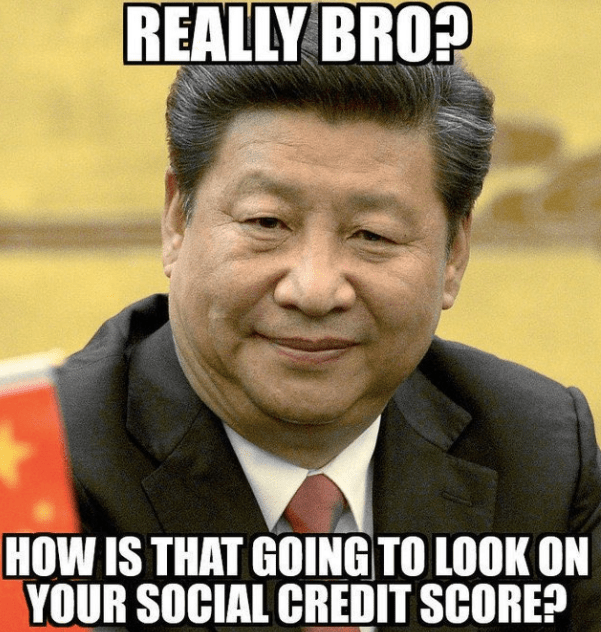
In 2014, the Chinese government revealed a plan for a future social credit system with the goal of all businesses receiving a “unified social credit code”,(1) and citizens being assigned an identity number which will be a public record. They are planning on putting this system into place by 2020, and over time companies have been collecting data which is going towards government research. The social credit system will analyze all aspects of human life and create a score that others can judge each other for trustworthiness. There are a lot of different aspects that will go into account. Some examples are, if you are caught jaywalking they have a well developed facial recognition system to mark down whoever does so. If you aren’t courteous to your neighbors such as playing music too loud or being too loud in public. It also tracks how much you shop online, how you are paying your bills, and if you play too many videogames. Each time you do something that the government or others deem as negative go into your single number. This score has the potential to effect your life just like the black mirror episode. It can affect your ability to travel and wont allow you to buy a plane or train ticket. It also can affect whether you can buy certain property, or your ability to get a job that you have worked hard towards. This can also go into where your children go to school. Even dating websites are taking this score into account such as the “Baihe”(1) dating site where people can judge one another on their score.
This is very similar when comparing it to black mirror because as Lacie’s social score went down, she lost her job, her money and her friends. She was forced to downgrade houses, and wasn’t able to get certain cars or food because of it. This parallel is scary similar to the type of system china is trying to put in place. Something that scared people so much is already happening. Although this system isn’t fully developed or put into place there are already many affects of this. For example, a Chinese journalist named Liu Hu(1) wrote a lot about the corruption of government in china. Because he spoke his mind he got arrested and blacklisted by the Chinese government. This means he’s on a “dishonest persons list”. The worst part about it is there’s no formal laws regarding the social credit score, so there was no official police warrant that placed him under this category. This makes people feel even more that their rights could be stripped away just as easily. This idea that makes people feel very unsafe is what has been causing many mental health issues with social media in general over the passed decade.
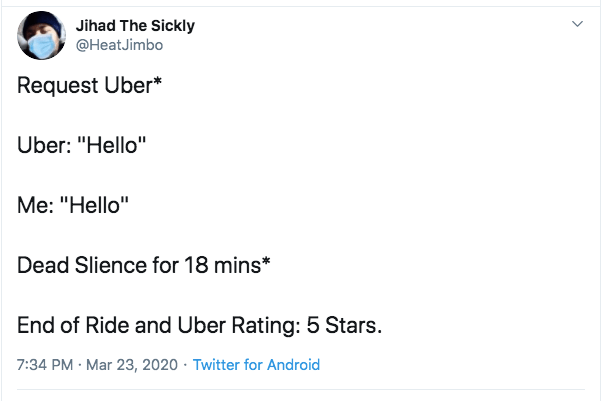
For example, uber and other applications in western society already offer the option of rating people. We all know what it is like to be a little nicer to the Uber driver so they consider our rating higher. This is the first step to following the Chinese government’s new system. Researchers have estimated that we will go from having a differing online and offline identity to solely having an “onlife”(2) identity. This means that your virtual identity will merge with who you really are creating no in between. Although people in western society think this is impossible, with the direction our government is moving, anything is really possible. In the future social media will be even more all consuming than it is right now.
For my Wikipedia article, I decided to write an article about the Sway House in Los Angeles. The reason I chose to write about this is because I knew for a fact there is not much information on social media collaboration houses on the internet. Initially I was going to write about the Hype House, which is the more popular social media collaboration house. I looked up on Wikipedia using the search tab, “hype house”, and nothing came up.
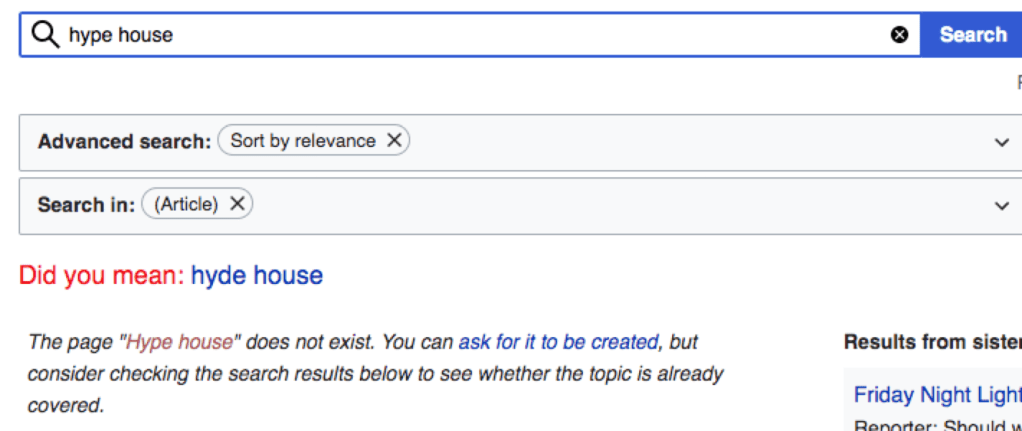
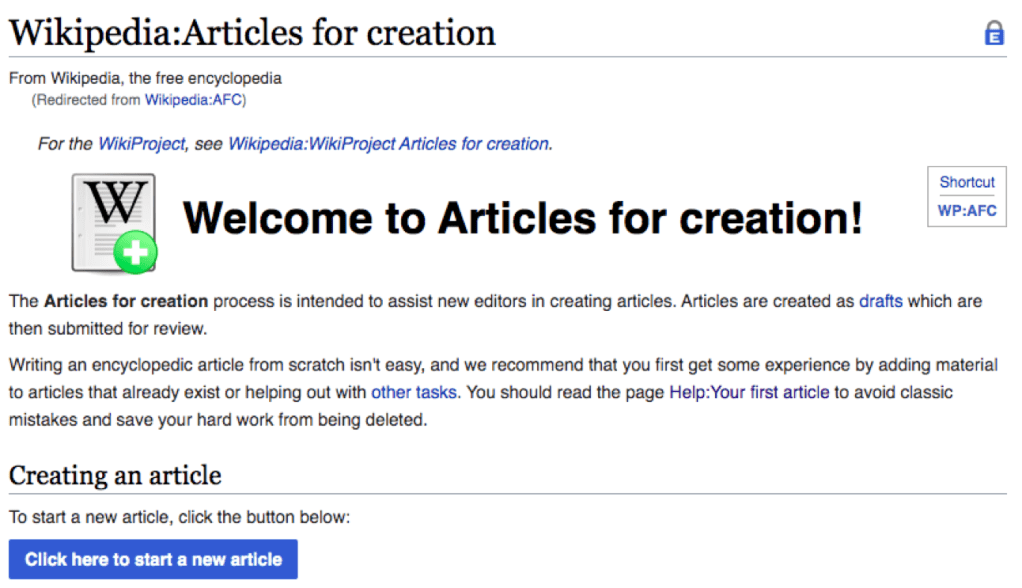
Later that day I found that someone had just made a Wikipedia article on the hype house, so I was no longer able to use this. Then I remembered that I saw on social media that there was a competing group called the sway house. The sway house did not have much publicity therefore making it the new subject of my article. I then decided to submit a proposal through “WP:AFC” which is where you submit articles for creation. You have to get this approved in order to make an article. I then began to write and article by composing the article in something called the sandbox.
There I was able to familiarize myself with the editing tools that Wikipedia provides to write an article. They have a lot of different tools such as ways to cite a person and put name references. There is also error check to help decrease the amount of errors the article contains to it can eventually go through less of a screening process. They also have places where you can insert symbols and many different languages.
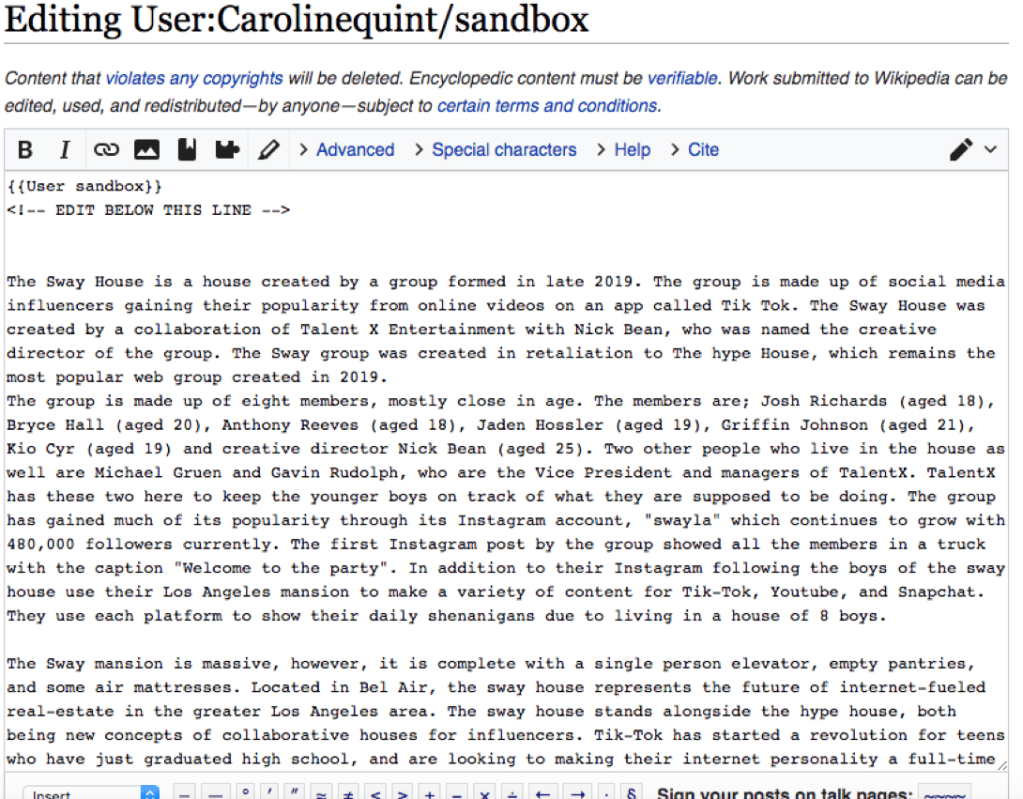
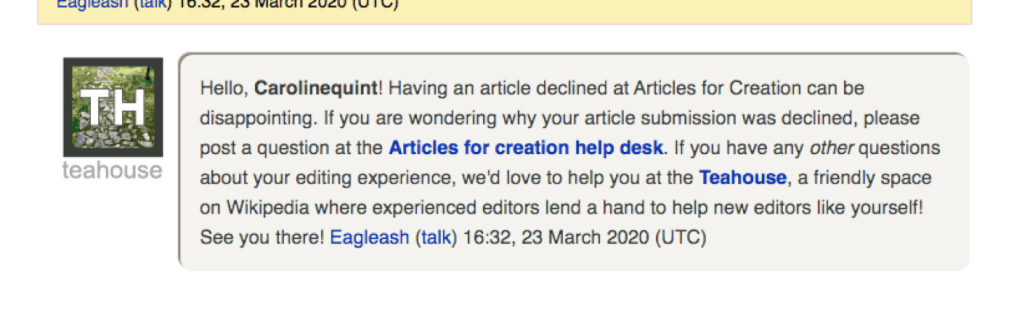
I then had my article declined by reviewing articles for consideration. This makes sense due to the errors I had in connecting my account to the sway house and making it legitimate. I then referenced back to the video that was provided about how to create a Wikipedia article. I followed the steps again and was able to have it approved to be written.
Then, when it came to writing the article I had a lot of issues finding information on the internet that pertained to the sway house because the hype house is the most prominent one. I looked at different websites that provided information on the different members, why they started the sway house, their social media accounts, and everything that went into starting it. I had to do research on many different websites by watching their YouTube videos, analyzing their social media and so on. I also used my personal knowledge that I have gathered form just following these influencers on social media and the information they have provided personally.
Finally when I finished writing the article I had a lot of trouble citing on the Wikipedia page because it was hard to follow the instructions pertaining to this. I then submitted the article for review and posted it to Wikipedia. I made sure to correct my spelling and make sure I had all my facts straight.
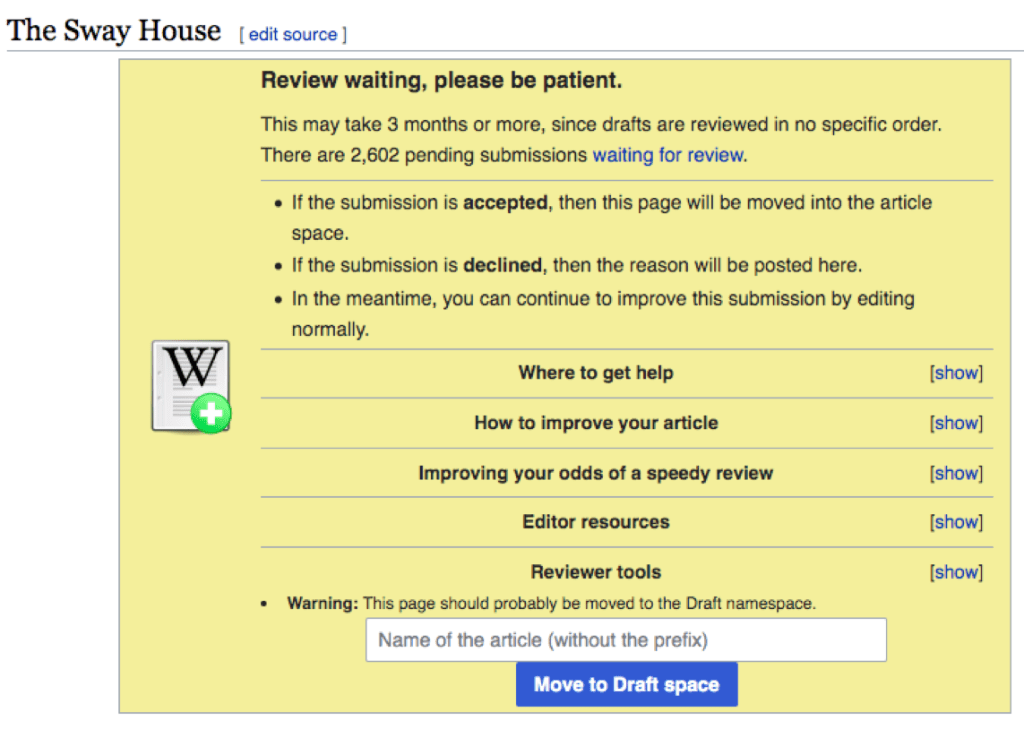
It shortly after told me that they were denying my article. I think this is because my article was too impartial and it didn’t give all the right facts of the sway house. If there was more information on the internet it would have made it easier.
Generational stereotypes have always been very common, but some of the most talked about as of recently come from Millennials. Millennials’s are one of the most misunderstood generations in centuries. There is a lot of buzz generated around how millennials do things differently, and are the children of a time where technology is all consuming. We are often misjudged, based on how the world sees us. There are many myths about our generation, which is taking away from our individuality. The first myth that is common is about how millennials are lazy. Baby boomers and generations alike love to speak on how my generation slacks off of real life responsibilities. However in a scholarly article by Stephanie Van Dellen(1), she discusses a World Leadership Survey that was conducted (Deal & Levinson, 2016.) In this survey they found that Millennials are not just “entitled and lazy,” but rather “entitled and hardworking.” This misconception comes from the fact that they think millenials only care about partying, which is another myth. In reality, Millennials just value having a life outside of work, and are willing to work even harder to have this life.
The element of millennials being party people is another common theme that older adults like to mention. Our generation is known for sex and partying, when in reality, we really like to chill more than others. In an article by Ryan Inzana(2), he points out that “three quarters of millenials like to stay in on weekends” which is an interesting fact to consider. Another fact Inzana mentions is 75% of millennials drink in moderation. These facts prove the Baby Boomers wrong who believe that all we care about is partying. This ties in as well to the misconception that we don’t do traditional dating culture. The hook up culture is more common than ever, and it makes it harder for people out age to find spouses. There is more of an emphasis on being single and independent. People think millennials are afraid of marriage, however this isn’t the case, it is just that we like to marry later. Instead of jumping to marriage in our early twenties, people have been waiting until the age of 30 to settle down.
Not only are there many myths about millennials, but there are also a lot of commonly known truths as well. One truth about millennials is we are very untrusting. There are so many fake people in the world these days, that people are hesitant to trust others, especially due to technology. Due to a decrease in face to face interactions, it has taken a toll on human interation, and social skills have definitely gone down. Another interesting truth that millennials possess has to do with lacking basic life skills that most of our parents grew up with. Whether it comes to relying solely on technology for things like navigating, if it weren’t for technology we would be useless in that area. Another thing we lack skills on is house chores, such as laundry a or handy-work. This points out that millenials are not necessarily lazy, but we definitely are underexposed to these helpful skills to use throughout life. We take to the internet usually, and just look everything up for instruction on how to do general things.
HEART. CHECK. pic.twitter.com/iDwEYbkNGx
— Millennial For Christ (@MLNLph) February 11, 2020
Social media is indirectly the primary issue when it comes to millennials differences from other generations. We use social media for all aspects of our lives. When it comes to dating, applying for jobs, traveling, and just how we show ourselves to the world, social media is all consuming. This creates an image of yourself that you crafted completely, allowing you to be anyone you’d like to be while online. This comes with both danger and power. The danger lies within human interactions being surface level, and based on appearance now more than ever. We get all of our news and ideas about the world from online, nothing is in writing anymore. People have the ability to post whatever they want, even if it is misleading information. This ties into the idea that millennials don’t know what’s going on in the world. People communicate often by posting on each others social media. As if comments were a way to have a conversation with others. In a scholarly article by Amanda Lenhart(3), “Fully 86% of teen social network users post comments to a friend’s page or wall, and 83% have added comments to a friends picture”. This just shows that millennials are overusing social media. This is a common stereotype that does stand true for my generation.
Because we were born in a time of the birth of the internet, millenials are often blamed for the current practices on social media and the changing world. In reality millennials are actually having a positive impact, and we are the future of technology. The new media literacies provided allow us to have the world at our fingertips. With this new breadth of knowledge, anything is possible. This will hopefully make millennials stand out as one of the most well educated and motivated generations. We can make an impact that will change the world forever.
2. Bailey, Ainsworth Anthony, and Mohammed Slim Ben Mimoun. “Consumer Social Orientation-Based Personality and Social Media Use: an Exploration among Young US Consumers.” International Journal of Internet Marketing and Advertising 10, no. 1/2 (2016): 1. https://doi.org/10.1504/ijima.2016.076977.
3. Smith, J.w. “Ten Truths about Millennials (Characteristics of People Belonging to the so-Called Millennial Generation&).” Strategic Direction 27, no. 9 (2011). https://doi.org/10.1108/sd.2011.05627iaa.012.
This is an example post, originally published as part of Blogging University. Enroll in one of our ten programs, and start your blog right.
You’re going to publish a post today. Don’t worry about how your blog looks. Don’t worry if you haven’t given it a name yet, or you’re feeling overwhelmed. Just click the “New Post” button, and tell us why you’re here.
Why do this?
The post can be short or long, a personal intro to your life or a bloggy mission statement, a manifesto for the future or a simple outline of your the types of things you hope to publish.
To help you get started, here are a few questions:
You’re not locked into any of this; one of the wonderful things about blogs is how they constantly evolve as we learn, grow, and interact with one another — but it’s good to know where and why you started, and articulating your goals may just give you a few other post ideas.
Can’t think how to get started? Just write the first thing that pops into your head. Anne Lamott, author of a book on writing we love, says that you need to give yourself permission to write a “crappy first draft”. Anne makes a great point — just start writing, and worry about editing it later.
When you’re ready to publish, give your post three to five tags that describe your blog’s focus — writing, photography, fiction, parenting, food, cars, movies, sports, whatever. These tags will help others who care about your topics find you in the Reader. Make sure one of the tags is “zerotohero,” so other new bloggers can find you, too.

 Site Title